A place to bird · Alto Alentejo
Serra de São Mamede
Raptors over the roof of the Alentejo
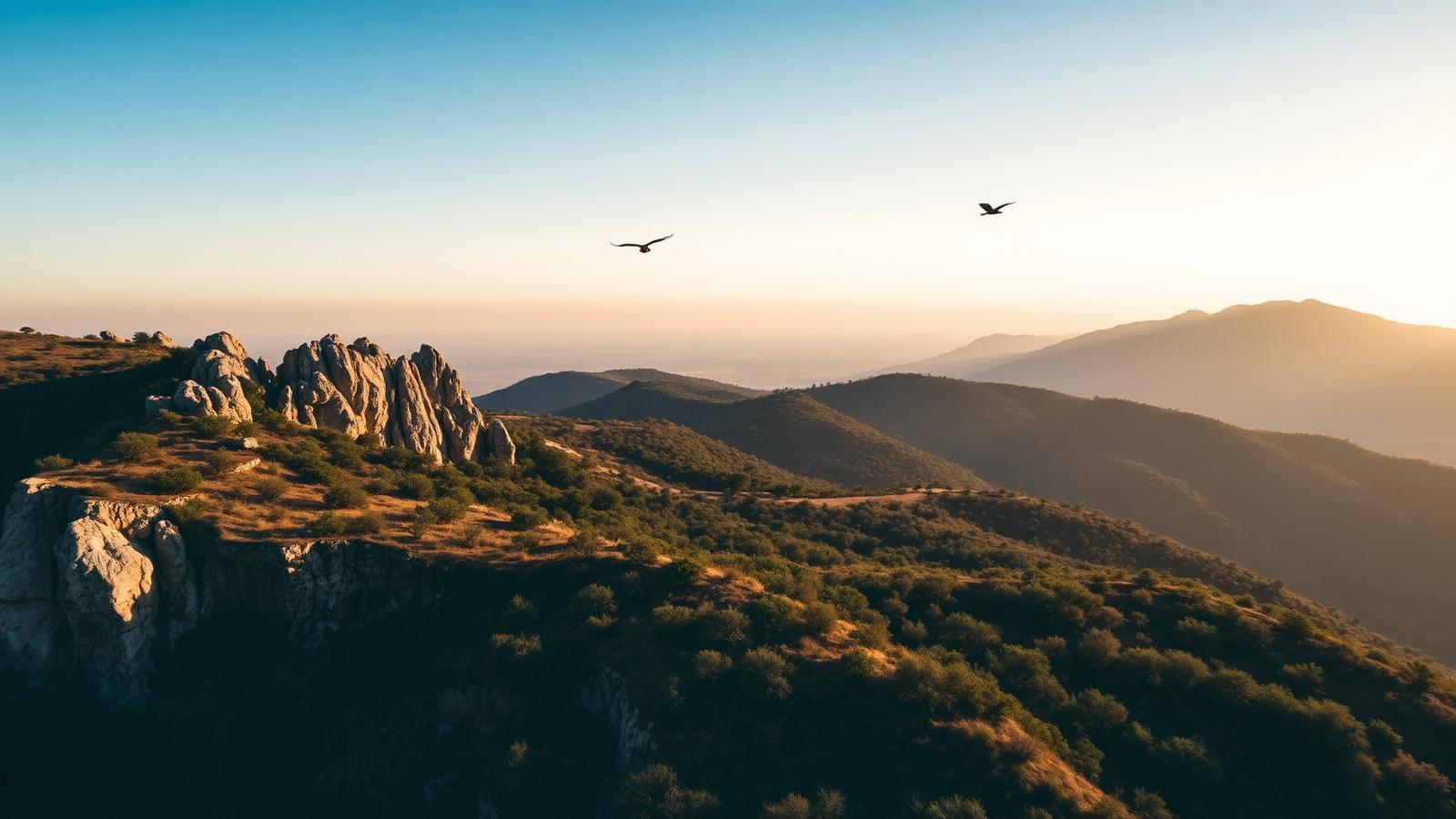
Rising to 1,025 metres, Serra de São Mamede is the highest ground south of the Tagus — a green, granite island lifted above the Alentejo plain. The range catches the weather the lowlands never see, and that single fact explains everything a birder finds here: more rain, more shade, chestnut and oak on the northern slopes, cork and holm oak to the south, and a density of life unusual for southern Portugal. Over 200 bird species have been recorded in the park. Its emblem is the Bonelli's Eagle, and on a clear morning the ridgelines belong to vultures.
But these heights were never empty of people. The same ridges that give the vultures their updraughts gave Marvão its impregnable vantage, gave smugglers their night paths into Spain, and gave the Romans a reason to bridge the Sever below. You come to São Mamede for the birds; you stay because the mountain has been read, walked and defended for three thousand years.
The newsletter
What's flying now
A short, seasonal note from the Serra — what to listen for, what's passing through.
Where it is
Map — to come
The park straddles the hills northeast of Castelo de Vide, your base, and runs to the Spanish border. Everything on this page is within a 25-minute drive of town.
- From Castelo de Vide
- Distance & entry point — to come
- Coordinates
- Main viewpoint — to come
- Parking
- Notes from the ground — to come
What you'll see
The park is, above all, raptor country. The headline birds:
- Bonelli's Eagle →
The park's symbol; resident, territorial, best scanned for along the rockier ridges.
- Griffon Vulture →
The reliable star. The rocky spine of the Fraga da Esparoeira — the Portuguese flank of a single crag the border splits in two (it becomes Puerto Roque on the Spanish side) — is a classic place to watch them ride the morning thermals. The vultures, of course, keep no passport.
Cinereous (Black) Vulture & Egyptian Vulture
Both possible overhead; the Egyptian a summer visitor.
Short-toed (Snake) Eagle & Booted Eagle
Summer raptors hunting the open slopes; the Short-toed often hangs on the wind over the same hillsides.
Black & Red Kite
With Eurasian Eagle-Owl at dusk, and a chance of Golden Eagle.
- Black Stork →
Shy and elusive, working the quieter river reaches below.
Away from the raptors, the woods and walls hold Iberian Azure-winged Magpie (an Iberian near-endemic, sociable and unmistakable), Golden Oriole heard before it's seen, Rock Bunting, Spanish Sparrow, and the raven over the crags.
Best time & light
- Late March to early June is the peak: resident raptors displaying, summer visitors arrived, the slopes loud with song and colour.
- Mid-September to early November for the second window — calmer and clear.
- Early morning is everything here — the vultures wait for the thermals to build, so the ridges come alive a couple of hours after first light. Go up early, be in position, wait.
- Summer middays are hot and quiet; winter mornings are cold (São Mamede is one of the few corners of the Alentejo that sees snow), but raptors are still resident year-round.
See the full month-by-month picture on the Seasonal calendar →
On the ground: three ways in
The high viewpoint
The peak itself is the best belvedere south of the Tagus — a place to set up, scan the sky, and let the raptors come to you.
Access & conditions — to come.
Galegos and the smugglers' path
From the border hamlet of Galegos, the old contraband route climbs a medieval stone way toward Pitaranha — the same paths Spanish smugglers once crossed in the dark. It runs in full view of the Fraga da Esparoeira, where the griffons gather, and returns over the medieval bridge of Pomar Velho. Walking history and watching vultures, on one circuit.
Porto da Espada and the chestnut woods
The little hamlet of Porto da Espada sits among some of the largest chestnut stands in the whole Alentejo — old hollow trees that draw the hole-nesters: woodpeckers (green, great and lesser spotted, Iberian), tits, nuthatch, and a scatter of upland passerines. Slower, woodland birding, in deep shade.
Portagem and the Sever
Down at Portagem, poplars line the banks of the River Sever beside a Roman road, watched over by a medieval tower built to guard the bridge below. Quieter water-edge birding, with two thousand years of crossing-points written into the valley.
Pair it with
The human mountain
The birding doesn't end at the treeline; it sits inside one of the oldest inhabited landscapes in Portugal. Make a day of both:
- Marvão →
The fortified eagle's-nest town on the highest ridge, with views deep into Spain. Watch raptors from the walls.
- Castelo de Vide →
Your base: castle, the medieval Jewish quarter, the fountain-lined streets.
- Roman Ammaia →
The Roman town at the foot of the range, by the Sever.
This is the rule of the whole site: the fraga that holds the vulture's nest also holds the watchtower. Never separate them.
Make it a trip
The ridges at dawn, the medieval town at dusk — from a single base in Castelo de Vide.
We'll build a São Mamede day into a stay across our three houses, matched to the season and to what you most want to see.